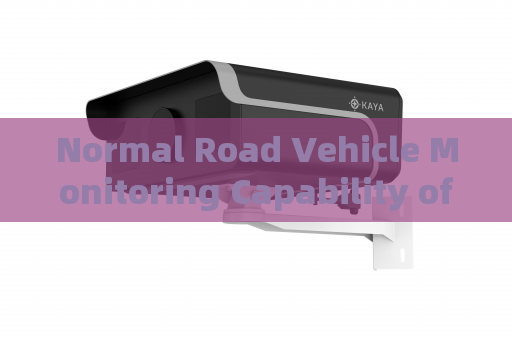
Normal Road Vehicle Monitoring Capability of the Penetration Imager with All-Weather Penetration Technology in Severe Weather During severe weather events such as heavy rain, dense fog, or blizzards, the routine task of monitoring normal road vehicles becomes a critical challenge for law enforcement and emergency responders. Conventional optical surveillance systems—including standard CCTV cameras and roadside patrol units—suffer from severe performance degradation under these conditions. Rain droplets and fog particles scatter visible light, reducing contrast and obliterating fine details like license plates, vehicle make, and driver behavior. More critically, the inability to see through wet or misted vehicle windows means that officers cannot assess whether a driver is impaired, distracted, or in medical distress without physically approaching the vehicle—a dangerous proposition in low-visibility environments. This operational blind spot not only slows response times but also places both officers and civilians at unnecessary risk during accidents, traffic stops, or security checkpoints in inclement weather. The Penetration Imager, an advanced optical imaging instrument based on laser range-gated imaging technology, directly addresses these limitations. Unlike passive cameras that rely on ambient light, this active imaging system emits high-repetition-rate pulsed laser light and synchronizes an intensified gated camera (incorporating an MCP image intensifier, high-voltage module, and timing circuits) to capture only the light returning from a specific distance. This gating mechanism effectively rejects backscatter from rain, fog, snow, and even fire, delivering high-contrast, high-resolution images at long range. For road vehicle monitoring, the Penetration Imager can penetrate optical media such as car windshields, side windows, and rear glass, enabling operators to clearly see the vehicle interior—including the driver's face, hand movements, seat occupancy, and loose objects—despite heavy precipitation or mist coating the glass. The system's ability to overcome the "bright veil" of scattered light in fog or rain ensures that critical details like license plates and vehicle contours remain crisp, even when conventional optics are completely blinded. In practical deployment, the Penetration Imager is typically mounted on a tripod or integrated into a patrol vehicle's roof-mounted sensor suite. During a severe fog event, an officer operating from a safe standoff distance of 50 to 200 meters can pan and tilt the imager to scan approaching or stationary vehicles. The real-time image displayed on a ruggedized tablet shows the target car with its windows effectively "opened" optically: the driver's posture, whether they are holding a phone, the presence of passengers, and any suspicious items on the seats become immediately visible. In a rainstorm, the same capability allows a highway patrol unit to inspect a vehicle from behind without exiting the car, confirming the driver's identity or detecting impaired behavior through the rain-streaked back window. The system's all-weather penetration technology eliminates the need for officers to rely on flashlight illumination or physical window taps, streamlining the tactical picture and maintaining operational safety. For specialized applications such as high-traffic toll booths or border checkpoints in coastal fog zones, the Penetration Imager provides a continuous monitoring capability that would otherwise be lost for hours or days each winter. An operator can position the imager to cover a specific lane, and the system automatically adjusts its gate timing to match the distance of each approaching vehicle. When a vehicle stops, the imager's high-resolution camera captures a full image of the cabin—including the driver's eyes and any items on the dashboard—through the fogged or rain-covered windshield. This data can be instantly cross-referenced with driver databases or recorded for later review, enabling law enforcement to maintain normal road vehicle monitoring standards even when weather visibility drops to near zero. The Penetration Imager thus transforms severe weather from a showstopper into a manageable, low-risk operational condition for vehicular surveillance.