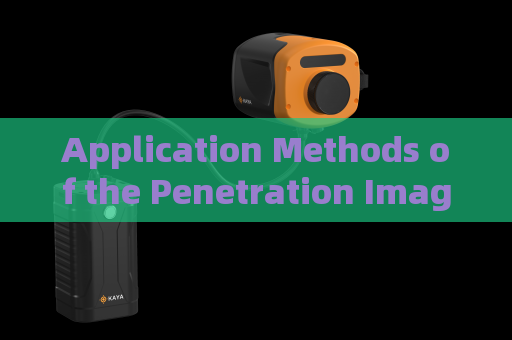
Application Methods of the Penetration Imager for Helping Law Enforcement Covertly Gather Evidence Before Taking Action A critical pain point in pre-raid reconnaissance is the inability to visually confirm what lies inside a vehicle without compromising the operation. Suspects often use heavily tinted windows, reflective glass, or interior curtains to shield illicit activities—whether drug trafficking, hostage situations, or explosive device preparation. Traditional binoculars or optical scopes fail under these conditions, while physical approach risks alerting the subject. Even with ambient light, glare and low visibility hinder precise intelligence gathering. Without a reliable optical solution, law enforcement must rely on guesswork or delayed tactical decisions, increasing danger for both officers and civilians. The need for a covert, non-contact imaging system that penetrates standard automotive glass while remaining invisible to the target has become an operational necessity. The penetration imager addresses this exact challenge through its laser range-gated imaging technology. It employs a high-repetition-rate pulsed laser, an intensified gated camera with MCP image intensifier, and timing modules to selectively capture returning light from a specific distance. By precisely gating the camera shutter to open only when the laser pulse returns from the target area beyond the glass, the system rejects backscatter and reflections from the window surface. This allows the imager to see clearly through windshield, side windows, and rear glass—even if they are coated, tinted, or wet. The active illumination ensures high-contrast images in pitch-dark conditions, and the narrow spectral bandwidth minimizes detection by the subject. Unlike passive night vision, this device works against strong ambient glare and can operate from a safe standoff distance of several hundred meters. In field application, a two-person tactical team deploys the penetration imager from a concealed position, such as a parked van or foliage cover. The operator aims the unit at the target vehicle, adjusts the focusing lens, and sets the range gate to match the distance to the interior plane behind the glass. A live feed appears on a ruggedized tablet display, revealing occupants, objects, or weapons that were previously invisible. During a recent counter-narcotics operation, agents used the imager to confirm the presence of a handgun on the dashboard and a second suspect lying in the back seat—information that redefined the entry plan. The device operates silently, with no audible or visible signature, and the laser output is eye-safe for all ranges. This capability allows commanders to conduct a full interior reconnaissance without ever stepping into the danger zone. The penetration imager further excels under adverse optical conditions common in tactical environments. Heavy rain, fog, or dust storms that degrade conventional optics do not significantly impair the laser range-gated system, as the short-duration pulse and gated reception effectively filter out scattering particles. When a vehicle is parked near a fire or bright light source, the imager maintains image integrity by rejecting the extraneous light outside the gate window. This resilience ensures that evidence gathering remains possible even when weather or debris would otherwise shut down visual surveillance. Every frame captured is time-stamped and can be logged for legal documentation, making the device not only a tactical tool but also an evidentiary one. By providing undeniable visual proof before action, the penetration imager reduces uncertainty, minimizes force escalation, and saves lives in high-stakes law enforcement missions.