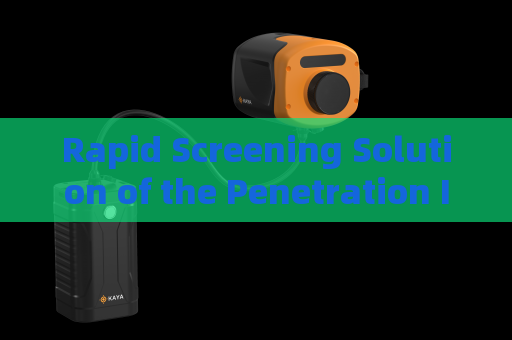
Rapid Screening Solution of the Penetration Imager for High-Reflective Mirror-Film Vehicles with Through-Tint Imaging High-reflective mirror-film vehicles present a persistent challenge for law enforcement and security screening operations. When a vehicle is fitted with such a film, the exterior surface resembles a mirror, reflecting ambient light and making it nearly impossible to see inside. Even under direct sunlight or strong artificial illumination, the interior remains hidden. This becomes a critical safety concern during roadside checks, checkpoint screenings, or suspect vehicle stops—officers cannot assess whether the driver or passengers are holding weapons, whether there are hidden contraband, or whether the vehicle is occupied by unauthorized individuals. Traditional optical tools, such as flashlights or high‑intensity lamps, only exacerbate the glare without improving visibility. The need for a reliable, non‑invasive solution that can rapidly penetrate both the reflective film and tinted glass is therefore acute. The penetration imager, an advanced optical instrument built on laser range‑gated imaging technology, directly addresses this operational gap. The penetration imager solves this problem by employing a pulsed laser source synchronized with an intensified gated camera. When aimed at a high‑reflectivity mirror‑film vehicle, the system emits short, high‑repetition‑rate laser pulses. The gated camera opens its electronic shutter only for the precise time window corresponding to the return of the laser light reflected from objects behind the glass. This technique effectively rejects the strong surface reflection from the mirror film and the scattered light from the tinted layer, allowing only the target image inside the vehicle to be captured. The core components—a high‑repetition‑rate pulsed laser, an image‑intensified gated camera (with a microchannel plate, high‑voltage module, and timing module), a beam expander, and an imaging lens—work together to deliver high‑contrast, clear imagery through optical media. Because the penetration imager is an active system that overcomes backscatter and ambient interference, it can obtain usable images even when the vehicle glass is deeply tinted or coated with a mirror‑film. In practical deployment, operators set up the penetration imager at a safe standoff distance—typically several dozen meters—and point it at the vehicle. The system’s real‑time display shows a detailed view of the cabin interior, including the driver, passengers, and any items on seats or in the footwell. During a recent field trial at a security checkpoint, officers used the device to screen a fleet of high‑end sedans with mirror‑finish aftermarket films. Within seconds per vehicle, the penetration imager revealed occupants and cargo that would otherwise have required physical approach and window tapping. This dramatically reduced the time needed for each check while keeping officers at a safer distance. The ability to operate in bright sunlight or under artificial lighting—conditions that typically defeat conventional binoculars or optical scopes—makes the penetration imager a versatile tool for highway patrol, border security, and VIP protection details. The operational procedure remains straightforward and does not require specialized training. The penetration imager is tripod‑mounted or handheld, with a single‑button activation for rapid screening. Operators observe the display and interpret the imagery without needing to adjust complex parameters. Because the device relies purely on laser light and optical detection, it poses no health or privacy concerns beyond those of standard laser safety compliance. For law enforcement agencies tasked with monitoring high‑reflectivity mirror‑film vehicles, this solution fills a critical capability gap. The penetration imager ensures that what lies behind the glare is no longer a blind spot, enabling faster, safer, and more informed decision‑making at every checkpoint or roadside encounter.