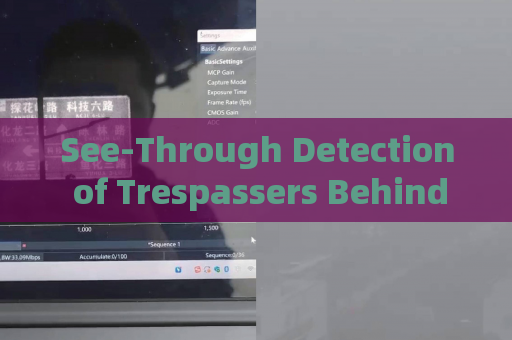
See-Through Detection of Trespassers Behind Sand Walls by the Penetration Imager in Zero-Visibility Border Conditions Border surveillance in arid regions faces a persistent and formidable challenge: the sudden onset of sandstorms and the deliberate use of sand or dust walls by trespassers to obscure movement. Under these zero-visibility border conditions, conventional optical and thermal surveillance systems are rendered ineffective. The airborne particulates scatter and absorb light, drastically reducing visibility and creating a uniform thermal signature that masks human targets. The critical pain point is the inability to achieve timely, positive identification of individuals concealed behind these naturally occurring or artificially created optical barriers, creating dangerous gaps in perimeter security and response protocols. This scenario demands a technological solution capable of definitive see-through detection to maintain operational integrity. The penetration imager addresses this specific vulnerability through its core technology: laser range-gated imaging. This active imaging system is uniquely engineered to overcome the limitations posed by particulate matter in the air. Its operation hinges on synchronizing a high-repetition-rate pulsed laser illuminator with a gated, intensified camera. The laser emits short, powerful pulses of light that travel through the obscurants. The camera's shutter, or gate, remains closed until the precise moment the laser pulse reflects off the target of interest—in this case, a potential trespasser behind a sand wall—and begins to return. By selectively capturing only this returning light and rejecting the vast majority of light scattered back by the intervening sand or dust cloud, the system effectively "sees through" the optical medium. The key components, including the pulsed laser, the beam expander, the imaging lens, and the intensified gated camera with its micro-channel plate and timing modules, work in concert to achieve high-contrast imaging. This process allows the penetration imager to isolate the target from the obscuring background, providing a clear visual advantage where other systems fail. In practical application, operators deploy the penetration imager from fixed observation posts or mobile patrol vehicles directed at known high-risk border segments. During a sandstorm or when intelligence suggests obscured activity, the system is activated. The operator adjusts the range gate to correspond with the estimated distance to the sand barrier. The resulting display cuts through the blowing sand, revealing activity directly behind the wall. Individuals attempting to use the reduced visibility for cover are clearly discernible, allowing for positive identification and intent assessment. The system’s long operational range and high resolution enable security forces to maintain a safe standoff distance while gathering decisive evidence. Command centers receive real-time imagery, facilitating immediate and appropriate interdiction responses. The ability to reliably deliver intelligence in such conditions transforms the operational picture, turning a blanket of obscuration into a transparent window. The effectiveness of this see-through detection is further underscored in varied but related zero-visibility scenarios common to border environments. Beyond sandstorms, the penetration imager maintains performance in thick fog, haze, and precipitation—conditions that frequently plague coastal or mountainous frontiers. Its capability to penetrate not only airborne particulates but also uniform optical mediums like certain vehicle windows or shelter materials adds a layer of versatility. For instance, it can be used to screen the interior of vehicles stopped at checkpoints during a dust event. However, its application remains strictly bound to the domain of light and optical media. The technology provides a critical, unambiguous visual feed that forms the basis for secure border management under the most challenging atmospheric conditions, ensuring that the cloak of nature or adversary action does not compromise territorial integrity.