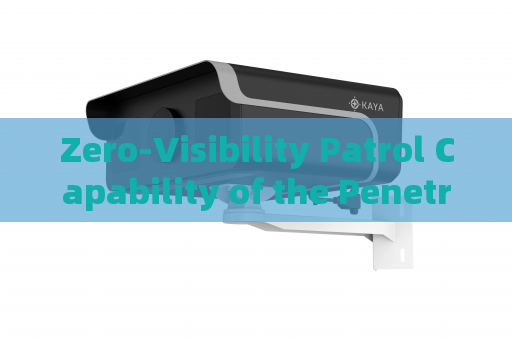
Zero-Visibility Patrol Capability of the Penetration Imager in Severe Sandstorm Border Environments addresses a critical operational gap in frontier security. Persistent and severe sandstorms drastically reduce visibility to near zero, rendering conventional optical surveillance and patrol efforts ineffective. These conditions create blind spots where border intrusions or illicit activities can occur undetected. Standard daylight cameras and thermal imaging systems struggle as their signals are scattered and absorbed by the dense particulate matter. The need for a reliable visual intelligence capability in such optical obscurants is paramount for maintaining continuous situational awareness and security integrity. The穿透成像仪 emerges as a dedicated solution to this specific environmental challenge. The core functionality enabling this capability is the penetration imager's laser range-gated imaging technology. This active imaging system operates by emitting precisely timed, high-repetition-frequency pulsed laser light. A synchronized gated camera, incorporating a microchannel plate intensifier and precise timing modules, opens its shutter only for the brief moment when the reflected light from the target returns. This temporal gating effectively filters out the overwhelming majority of light scattered by sand particles closer to the apparatus—the primary cause of visibility degradation. By rejecting this forward scatter, the system captures high-contrast images of objects hidden within the storm. This principle allows it to maintain clarity where passive systems fail, directly countering the sandstorm's obscuring effect. In practical deployment along sandstorm-prone borders, operators utilize the penetration imager from fixed observation posts or mobile patrol vehicles. The system is directed towards critical zones such as potential crossing points or remote sections of the perimeter. Despite the airborne sand creating a visual blanket, the imager's processed display reveals structural outlines, vehicles, or human figures at operational distances that would otherwise be invisible. The high-resolution output provides identifiable details, enabling accurate threat assessment and decision-making. Patrols can verify sensor alerts or investigate disturbances with visual confirmation, transforming a zero-visibility environment into a manageable, monitored space. The operational advantage is sustained over prolonged exposure to the abrasive and dense sand medium. Unlike some sensors whose performance degrades with particulate accumulation, the optical design of the penetration imager, including its beam expander and imaging lens, is engineered for resilience in such harsh conditions. The clarity provided effectively extends the visual reach of border guards, compressing the time between a potential breach and its identification. This persistent零可见度巡逻能力, powered by the穿透成像仪, establishes a reliable optical layer of defense, ensuring that severe weather no longer equates to a lapse in border security vigilance.