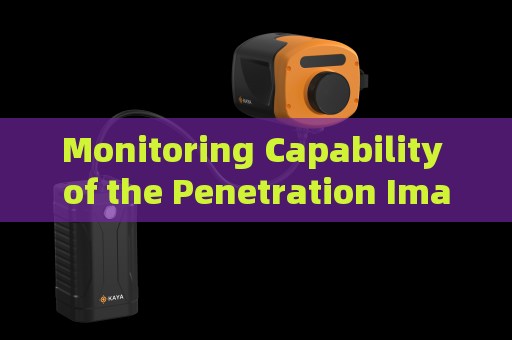
Monitoring Capability of the Penetration Imager for Nighttime Illegal Border Activities Under Zero-Light Imaging Conditions addresses a critical operational gap in border security. Nighttime and adverse weather provide cover for illicit crossings and smuggling operations. Traditional surveillance methods, including standard low-light cameras, often fail under conditions of total darkness, dense fog, or heavy precipitation. The challenge is to achieve clear, actionable intelligence in environments where there is zero ambient light and visibility is severely degraded by atmospheric obstructions, rendering conventional passive sensors ineffective. The core function of the penetration imager that overcomes this challenge is its active laser range-gated imaging system. This technology utilizes a high-repetition-frequency pulsed laser source and a gated, intensified camera synchronized with precise nanosecond-level timing control. The system actively illuminates the distant scene with laser pulses. The camera's gate opens only for the precise duration when the reflected light from the target returns, effectively rejecting backscattered light from intervening atmospheric particulates like fog, mist, or light rain. This capability allows the penetration imager to see through such optical media with high contrast and resolution, where passive sensors see only a washed-out glow or nothing at all. It maintains performance in zero-light conditions by providing its own illumination, which is spectrally tailored and precisely controlled. In practical deployment along remote border sections, operators establish observation posts equipped with the penetration imager. The system is often integrated onto a stabilized pan-tilt unit for persistent, wide-area surveillance. During a night patrol or a specific monitoring mission under zero-light imaging conditions, operators activate the laser illuminator. The real-time feed reveals clear imagery of the landscape, cutting through atmospheric haze. Suspicious movements, such as individuals or vehicles approaching boundary markers, become distinctly visible at ranges exceeding one kilometer. The system can also be used to monitor known crossing points through vehicle windows or temporary shelters' glass surfaces, verifying activities without visible light signatures. The operational procedure involves scanning sectors, designating targets for continuous tracking, and recording high-resolution footage for evidence and analysis. The effectiveness of this monitoring capability hinges on strategic siting and understanding its functional boundaries. While the penetration imager excels against fog, light rain, and even the optical distortion caused by heat haze or flames near a border outpost, it does not penetrate solid objects. Its value lies in denying the concealment advantages of darkness and certain weather conditions to illicit actors. By transforming a pitch-black, fog-shrouded border zone into a observable space, it shifts the tactical advantage. This persistent surveillance capability under previously prohibitive zero-light imaging conditions acts as a significant deterrent and a force multiplier for border security personnel, enabling proactive intervention and secure apprehension.