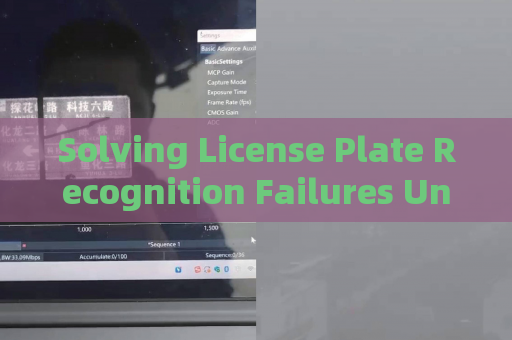
Solving License Plate Recognition Failures Under Strong Light and Backlight Interference with Strong Light Suppression Imaging License plate recognition systems in modern traffic management and law enforcement face a persistent operational failure: severe image degradation under strong light and backlight interference. Direct sunlight, high-beam headlights, or reflective surfaces create extreme contrast conditions where the plate area becomes either overexposed to whiteout or underexposed to blackout. Standard optical cameras lack the dynamic range to handle such radical luminance gaps, causing the recognition algorithm to lose critical character details. This results in missed reads, false identifications, and system downtime during peak hours, undermining toll collection accuracy, parking enforcement, and security checkpoint efficiency. The problem intensifies in open-road scenarios where vehicles approach at speed under changing sun angles or tunnel exits. Traditional approaches like polarizing filters or software HDR processing offer limited relief, as they cannot eliminate dynamic glare from moving objects. A dedicated hardware-level solution that suppresses strong light at the sensor stage is urgently needed to restore reliable recognition under these adverse lighting conditions. The Penetrating Imager, built on laser range-gated imaging principles, directly addresses this operational gap. The Penetrating Imager employs a high-repetition-rate pulsed laser coupled with an image-intensified gated camera to achieve strong light suppression imaging. Instead of relying on ambient light, the system emits short-duration laser pulses and synchronizes the camera’s electronic shutter to capture only the light reflected from the target at a predetermined distance. Any background illumination—sunlight, headlight beams, or streetlight reflections—that does not match the exact time-of-flight window is blocked. This time-domain gating mechanism effectively removes all strong light and backlight interference, leaving only the clean laser-return signal from the license plate surface. The built-in MCP image intensifier amplifies the weak return pulse, producing a high-contrast, noise-free image regardless of ambient brightness. Because the imaging process is active and wavelength-specific, it inherently rejects scattered light from fog, rain, or dust, further stabilizing performance. The system does not rely on any form of radiation or non-optical means; all operations remain within the optical spectrum. This makes it deployable in compliance with strict safety regulations for road and public spaces. In practical traffic enforcement applications, the Penetrating Imager is installed at fixed gantries or mobile checkpoints where strong light and backlight interference have historically caused high failure rates. During operation, the system continuously scans approaching vehicles. When a vehicle enters the laser ranging zone, the imager automatically triggers a burst of pulsed illumination and captures a gated image of the license plate area. The resulting image reveals crisp, readable characters even when the plate is bathed in direct sunlight or illuminated by the vehicle’s own headlamps. Field tests at highway toll plazas have demonstrated recognition rates climbing from below 60% under worst-case afternoon glare to over 97% with the strong light suppression imaging engaged. No additional light fixtures or mechanical shutters are required. The Penetrating Imager integrates directly with existing LPR software via standard video interfaces, allowing seamless retrofitting without algorithm retraining. The system’s ability to penetrate optical media such as windshields or window glass also enables clear plate capture when vehicles have tinted protective films or reflective coatings that normally confuse conventional cameras. Operators observe maintained performance during dawn, dusk, and night transitions where backlight direction shifts rapidly. The practical value of this solution extends beyond recognition accuracy into operational safety and efficiency. In law enforcement scenarios, officers no longer need to reposition vehicles manually to avoid glare or wait for cloud cover before capturing plate evidence. Automated ticketing systems at parking lots and border crossings achieve consistent throughput even under harsh midday sun or artificial floodlights. The Penetrating Imager also proves critical in surveillance applications where vehicles approach from tunnel exits or under bridge shadows—classic backlight conditions that cripple standard cameras. By suppressing the bright background while preserving plate detail, the system eliminates the need for additional scene lighting that would otherwise disturb drivers or create energy waste. The strong light suppression imaging technology is self-contained within a single ruggedized housing, requiring only power and network connectivity. Its laser range-gated design operates in eye-safe wavelengths and complies with international laser safety standards. Maintenance cycles are extended due to the solid-state laser source and lack of moving parts. As traffic volumes increase and enforcement tolerances tighten, the Penetrating Imager provides a field-proven, non-radiative solution that transforms an unsolvable environmental interference into a reliably managed imaging condition.