During a high-risk vehicle interdiction, law enforcement officers face a critical dilemma: the need to visually assess the interior of a suspect car while avoiding close approach that could expose them to ambush or explosive threats. Conventional binoculars or spotlights are rendered useless by window tint, external reflections, or glare from ambient light. Even with tactical mirrors, the limited field of view and the necessity of physical proximity place operators directly in harm’s way. This scenario demands a solution that delivers clear, real-time imagery through glass from a standoff position, thereby transforming a life-threatening task into a controlled, remote observation procedure. The core pain point is the impossible trade-off between safety distance and situational awareness — a gap that the Penetration Imager is engineered to close.
The Penetration Imager leverages laser range-gated imaging technology to overcome the optical barriers of windshields and side windows. By emitting nanosecond pulses from a high-repetition-frequency laser and synchronizing the intensifier camera to receive only the light reflected from the target plane, it rejects backscatter caused by rain, fog, or glass surface reflections. This active imaging approach produces high-contrast, resolution-rich images of occupants, objects, and hidden compartments behind the glazing. The system’s built-in timing module allows the operator to adjust the gate delay, effectively “slicing” through multiple layers of glass and obscurants. Unlike passive optics that fail under glare, the Penetration Imager captures details as if the window were invisible — without requiring the officer to step within the danger zone.
In actual field deployment, the operator sets up the Penetration Imager at a secure distance, commonly 50 to 200 meters from the target vehicle, using a tripod or vehicle-mount. The compact integration of the pulsed laser, intensified gate camera, beam expander, and imaging lens enables rapid power-on and calibration. Through a ruggedized handheld display or a head-mounted unit, the officer views a live feed that reveals the driver’s hand positions, the presence of weapons, or the subtle movements of passengers. The ability to maintain visual contact while staying behind cover or inside an armored vehicle fundamentally alters the dynamics of tactical negotiation and entry decisions. Even under rain, fog, or low-light conditions, the Penetration Imager maintains reliable performance—though it should be noted that while it improves visibility through smoke by a factor of three to five, it cannot penetrate thick opaque smoke.
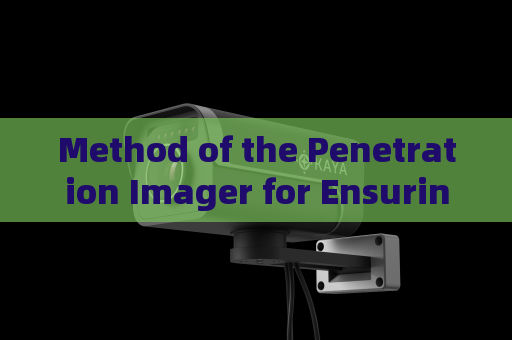
This standoff imaging capability directly supports standard operating procedures for vehicle checkpoints, hostage rescue, and high-risk traffic stops. The operator can continuously assess threat levels without triggering a suspect’s awareness, as the laser emission is invisible to the naked eye and silent in operation. In one documented counter-terrorism scenario, a team used the Penetration Imager to confirm that a stopped sedan contained no explosives behind the tinted rear window, allowing them to avoid a risky close-in verification. The technology thus transforms a historically vulnerable point—the moment of approaching a vehicle—into a secure, information-rich observation window. By keeping personnel out of the blast radius and direct line of fire, the Penetration Imager becomes an essential tool for mission success while upholding the highest operator safety standard. The method itself — using the Penetration Imager to maintain a secure distance — is now embedded in tactical doctrine for law enforcement and military units worldwide.