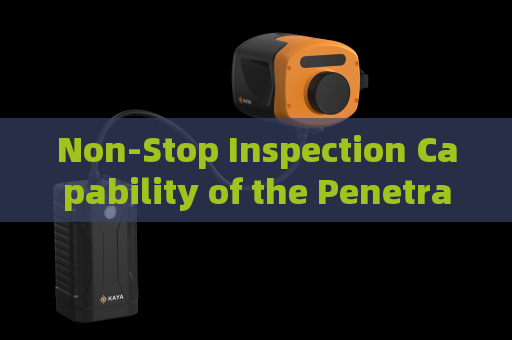
Non-Stop Inspection Capability of the Penetration Imager for Tinted Glass with Strong Light Suppression Imaging at Night Nighttime law enforcement and security patrols face persistent challenges when attempting to visually inspect vehicles with heavily tinted windows. The combination of dark glass, which significantly reduces visible light transmission, and intense ambient light sources such as street lamps or oncoming headlights creates a high-contrast, low-visibility environment. This scenario renders traditional observation methods ineffective, obstructing the continuous assessment of occupant activity or potential threats inside a stationary or moving vehicle. The need for a reliable, non-stop inspection capability under these exact conditions represents a critical operational gap, where safety and situational awareness are compromised by optical barriers and blinding glare. The penetration imager addresses this specific challenge through its core function of strong light suppression imaging synchronized with laser range-gated technology. As an active imaging system, it utilizes a high-repetition-rate pulsed laser source and a gated intensifier camera equipped with a micro-channel plate. The key lies in the precise temporal control between the laser pulse emission and the camera’s ultra-short gating window. This gating mechanism allows the system to selectively capture only the light reflected from the target plane—the window glass interior—while rejecting the overwhelming backscatter from airborne particles and, crucially, suppressing the intense, continuous waves of ambient artificial light. The penetration imager thus isolates the desired signal, enabling high-contrast imaging through the optical medium of tinted glass despite the hostile lighting environment. In practical application, an operator can conduct surveillance or inspection from a patrol vehicle or checkpoint without requiring the subject vehicle to stop. The system is directed at the target window. The pulsed laser illuminates the scene, and the gated camera, operating at nanosecond-speed windows, collects the returning photons. The strong light suppression capability ensures that glare from external lamps or reflections off the glass surface does not saturate the detector. The resultant image provides a clear view through the tint, revealing details of the vehicle's interior compartment. This process can be maintained continuously, offering real-time monitoring capability for dynamic situations. The penetration imager effectively turns the opaque tinted barrier into a transparent one at night, transforming a major vulnerability into a controlled parameter. This capability extends operational effectiveness to other complex scenarios involving optical media under strong light interference. For instance, during nighttime fire rescue operations involving structures with extensive glass facades or windows, the penetration imager can peer through flames and the glass itself to identify occupants or assess internal conditions, enhancing visibility by three to five times in such fire-affected environments. It is precisely engineered to overcome the obscuration caused by the optical media of fire, fog, or precipitation acting on the light path. However, its performance remains bound by the laws of physics governing light; it cannot penetrate non-optical solids like walls, nor can it defeat the absolute obscuration posed by thick smoke, which absorbs and scatters the laser light entirely. The technology's power is meticulously defined and deployed within this domain of optical penetration and active illumination.