Urban firefighting, particularly in high-rise structures, presents a critical challenge for first responders. The intense heat and blinding smoke at the heart of a blaze often render traditional thermal imaging ineffective for early interior assessment, forcing personnel to advance perilously close to unknown hazards. Gaining situational awareness through windows or glass curtain walls from a safe standoff distance remains nearly impossible with conventional equipment due to the overwhelming glare from flames and the obscuration caused by airborne particulates. This information deficit directly compromises operator safety and delays effective intervention. The imperative is clear: a technological solution capable of providing clear visual intelligence through optical barriers from a secure perimeter is essential for modern emergency response.
The penetration imager addresses this operational gap through its core capability of laser range-gated imaging. This technology functions by emitting precisely timed, high-frequency pulses of laser light. A synchronized, gated camera sensor opens its shutter for an extremely brief window, capturing only the light reflected from a pre-set distance corresponding to the target plane, such as a window. This temporal filtering effectively eliminates backscatter from intervening obscurants like fog, rain, or water mist from fire hoses. Crucially, it also suppresses the intense, scattered glare from flames and ambient light that would normally saturate a sensor. The system thus isolates the useful signal, enabling high-contrast imaging of the scene behind the optical medium.
In practice, an operator establishes a position at a secure distance from the building facade. After aligning the penetration imager with a window or glass panel, the operator adjusts the system's range gate. This action electronically "slices" through the luminous interference of the fire and atmospheric clutter, suddenly revealing a stabilized image of the interior space. The effect is transformative; a previously impenetrable sheet of flame and smoke against glass becomes a view into the occupancy, allowing for the identification of potential victims, structural integrity assessment, and fire spread evaluation. This reconnaissance occurs without exposing personnel to the immediate dangers of heat, falling debris, or potential flashover conditions at the window itself.
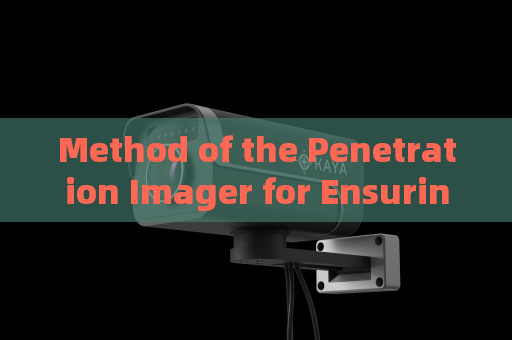
The operational paradigm shifts from risky, close-quarters probing to standoff intelligence gathering. Command personnel can deploy the penetration imager from the safety of an apparatus or a shielded position, mapping multiple access points and interior conditions before formulating an entry plan. The technology enhances fireground visibility by a factor of three to five in the presence of flame and light obscurants, although it cannot penetrate dense, opaque smoke. By maintaining a secure distance during the critical assessment phase, the method fundamentally reorders the sequence of response, prioritizing operator safety through advanced optical reconnaissance. The penetration imager thereby establishes a new standard for risk mitigation in complex fire environments.