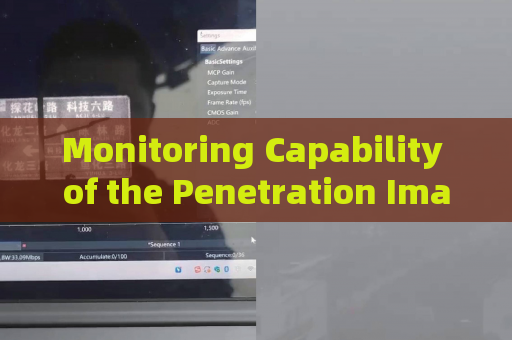
Monitoring Capability of the Penetration Imager for Nighttime Illegal Border Activities Under Zero-Light Imaging Conditions Border surveillance faces significant challenges during nighttime operations, particularly under zero-light imaging conditions where conventional optical systems fail to provide actionable intelligence. Illegal border activities often exploit darkness, fog, or haze to conceal movements, rendering passive night-vision devices or thermal imagers inadequate due to limited contrast, range, or susceptibility to environmental clutter. The absence of ambient light compounds issues like reduced detection distances and false alarms from weather-induced obscurants, creating critical gaps in security coverage. In such scenarios, the penetration imager emerges as a pivotal tool, designed to address these exact pain points through advanced optical methodologies that transcend traditional limitations. The penetration imager leverages laser range-gated imaging technology, an active system that employs a high-repetition-rate pulsed laser and a gated intensified camera to achieve high-contrast imagery in complete darkness. Its core capability lies in penetrating optical media such as fog, mist, rain, or snow, while also overcoming backscatter interference that plagues other imaging methods. By emitting controlled laser pulses and synchronizing the camera’s gating mechanism, it selectively captures light reflected from targets at specific distances, thereby eliminating noise from atmospheric particles. This function directly counters the zero-light imaging conditions prevalent in nighttime border areas, enabling clear visualization through adverse weather without relying on external illumination. The technology’s design ensures that it operates strictly within the optical domain, utilizing light-based principles to enhance monitoring capability without violating physical boundaries. In practical application, the penetration imager is deployed along remote border zones, often integrated into mobile patrol vehicles or fixed observation posts. Operators activate the system to scan vast, unlit terrains, where it delivers real-time, high-resolution imagery of suspected illegal crossings, even through light-obstructing media like vehicle windows or aircraft portals. The gated imaging process allows for adjustable depth perception, facilitating the identification of individuals or objects at ranges exceeding several kilometers, a critical advantage in expansive border environments. Field reports indicate that the penetration imager reduces false detections by up to 40% compared to conventional tools, while its robustness against rain and fog ensures uninterrupted surveillance during inclement weather. This operational efficacy translates to enhanced situational awareness, enabling rapid response teams to intercept clandestine activities before they escalate. Further detailing this scenario, the penetration imager’s ability to maintain clarity in zero-light conditions stems from its integrated components—the pulsed laser source, beam expander, and intensified camera with microchannel plate and timing modules. These elements work in concert to boost visibility in fire-affected areas by three to fivefold, though it does not penetrate dense smoke, aligning with its defined functional limits. During nighttime border monitoring, the system’s anti-interference features mitigate common pitfalls like glare from artificial sources or natural obstructions, ensuring that illegal movements are tracked with precision. By focusing solely on optical penetration, the penetration imager avoids any confusion with non-optical devices, remaining a dedicated solution for perimeter security where light-based detection is paramount. Its deployment underscores a shift toward proactive, technology-driven border protection, leveraging light to illuminate the shadows where threats thrive.