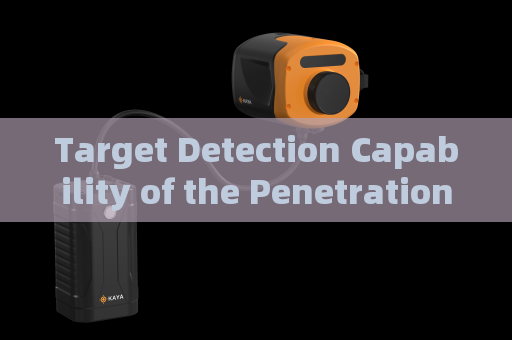
Target Detection Capability of the Penetration Imager with Fog Penetration Imaging When Severe Weather Conceals Suspicious Activities Severe weather conditions, particularly dense fog, present a formidable challenge for surveillance and security operations. When suspicious activities are intentionally conducted under the cover of such atmospheric obstructions, conventional optical and thermal imaging systems often fail. The suspended water droplets scatter and absorb light, drastically reducing visibility, contrast, and effective detection range. This creates critical blind spots, allowing clandestine operations, unauthorized intrusions, or illicit trafficking to proceed undetected in coastal areas, ports, or border zones. The fundamental problem is the severe degradation of image quality and the loss of actionable intelligence precisely when situational awareness is most crucial. The penetration imager addresses this specific impairment directly through its core fog penetration imaging capability. This advanced optical instrument is an active imaging system based on laser range-gated imaging technology. Its operation hinges on precise temporal synchronization between a high-repetition-frequency pulsed laser illuminator and a gated intensifier camera. The system emits short, powerful pulses of laser light. The camera's intensifier, incorporating a Microchannel Plate (MCP) and controlled by high-voltage and timing modules, remains electronically "closed" or gated off for a meticulously calculated brief period. This timing excludes the overwhelming backscattered light from the fog particles near the lens. The gate then opens only to collect the light reflected from the distant target, which arrives later. This process, facilitated by the beam expander and imaging lens assembly, effectively filters out the scattering noise, yielding a high-contrast image of the obscured scene. In practical deployment against weather-concealed activities, the penetration imager transforms operational effectiveness. Operators can maintain persistent surveillance of high-value perimeters or critical infrastructure approaches regardless of fog density. The system's ability to achieve clear imaging through optical media interference translates directly to extended detection ranges and superior resolution compared to passive sensors. For instance, monitoring a fog-shrouded harbor, security personnel can distinguish the silhouette and specific features of a vessel attempting a covert approach, identify activity on its deck, or read identifying markings that would otherwise be invisible. The target detection capability is thus restored, enabling timely threat assessment and interdiction. The operational advantage is sustained and reliable. The penetration imager’s active design and gated methodology provide immunity to the ambient lighting conditions that hamper other systems, whether in pitch darkness or the uniform glow of fog-lit nights. Its robust performance against fire, haze, rain, and snow further ensures continuity of surveillance across various severe weather scenarios that often accompany fog. This creates a persistent surveillance dome, denying adversaries the protective screen of adverse weather. The penetration imager, therefore, does not merely improve vision; it fundamentally reclaims the operational initiative for security forces by neutralizing a key environmental factor exploited for concealment.