The critical scenario of nighttime vehicle interception presents a persistent operational hazard: the intense glare from a suspect vehicle's headlights can completely obscure the driver's compartment. This luminous barrier creates a significant identification gap, preventing clear visual confirmation of the occupant's number, actions, or potential threats. Traditional surveillance and optical equipment fail in this high-contrast environment, where vital details are washed out by overpowering light, turning a standard safety procedure into a moment of heightened vulnerability and delayed decision-making.
This challenge is directly addressed by the advanced functionality of the laser range-gated penetration imager. The core solution lies in its precise temporal control, known as gated imaging technology. The system emits synchronized, high-frequency pulsed laser light towards the target. A key component, the gated intensifier camera, is electronically synchronized to open its shutter only for an exceedingly brief moment, precisely timed to capture the laser pulses reflected from the target vehicle while rejecting light from other time intervals. This process effectively filters out the continuous, blinding glare from the headlights, which falls outside the narrow detection gate. The penetration imager thus isolates the light signal from the area of interest—the windshield and cabin.
In practical application, an operator aims the penetration imager at the suspect vehicle. The system's laser illuminates the scene, and the gated receiver is adjusted to a specific range gate corresponding to the windshield's distance. The blinding headlight beams are electronically "subtracted" from the captured image. What remains is a high-contrast, clear image of the windshield and the driver's seat area. Operators can then identify the number of occupants, observe hands on the steering wheel, or detect overt threatening gestures, all through the optical medium of the glass, which the system is designed to penetrate. This capability transforms a dazzling whiteout into an intelligible visual assessment.
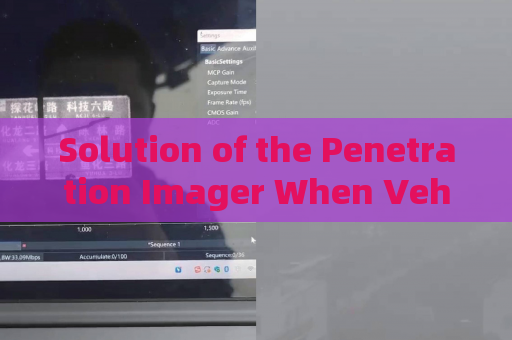
The efficacy stems from the imager's active imaging design and its inherent resistance to backscatter and intense, unstructured light interference. By controlling the light reception with nanosecond precision, it leverages the difference in light travel time between the direct glare and the reflected signal from the target plane. This technical approach ensures high-resolution imaging at considerable distances, turning the vehicle's own headlights from an obstacle into a contextual backdrop. The penetration imager provides a decisive advantage in high-risk traffic stops and surveillance, delivering critical identification data where conventional optics offer only a blinding shield.