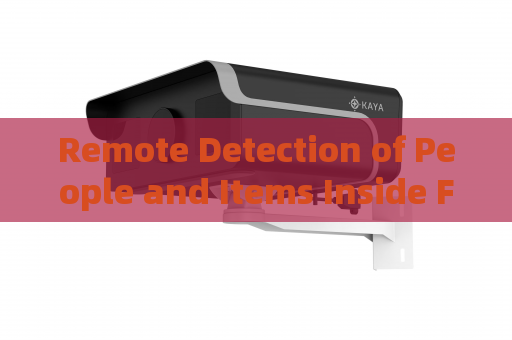
Remote Detection of People and Items Inside Fleeing Vehicles by the Penetration Imager addresses a critical and persistent challenge in law enforcement and public safety operations. During high-speed pursuits or when intercepting suspect vehicles, determining the interior situation poses significant risks. Traditional visual methods fail in low-light conditions, through tinted windows, or when obscured by weather phenomena. The inability to ascertain the number of occupants, their positions, or the presence of potential threats such as weapons prior to intervention drastically escalates the danger for officers and civilians alike. This intelligence gap demands a technological solution capable of delivering clear visual data through the vehicle's optical barriers under complex environmental conditions. The penetration imager fulfills this need through its core capability of remote, high-contrast imaging through transparent optical media. As an active imaging system employing laser range-gated imaging technology, it projects precisely timed, high-repetition-rate pulsed laser light. The gated camera, synchronized with the laser pulses, captures only the light reflected from the target plane—the interior of the vehicle—while rejecting backscattered light from interfering mediums like rain, snow, fog, or glare. This allows the system to effectively "see through" the vehicle's windshield and side windows, which are optical media, rendering a clear image of the cabin. The technology provides superior resolution at long operational distances and maintains strong resistance to various interferences, enabling reliable detection regardless of ambient light or common obscurants. In practical field deployment, the penetration imager transforms operational tactics. Mounted on a patrol vehicle or at a stationary checkpoint, the system can be activated as a suspect vehicle approaches or flees. Operators remotely obtain a real-time visual feed displaying the cabin's interior layout. This enables accurate assessment of occupant count, their posture, and the identification of conspicuous items, all from a safe standoff distance. The intelligence gathered is immediate and actionable, informing tactical decisions on whether to proceed with a stop, establish a perimeter, or employ de-escalation protocols. The system’s ability to enhance visibility through fire by three to five times also proves invaluable in post-collision scenarios, though it is not effective against thick smoke. This remote detection capability fundamentally shifts the risk calculus in vehicular interdictions. By lifting the veil of the vehicle's glass enclosure and mitigating environmental visual noise, the penetration imager provides a critical informational advantage. It allows for scenarios to be assessed based on concrete visual evidence rather than speculation, promoting more precise and safer resolutions. The deployment of such a penetration imager represents a significant advancement in operational awareness and officer safety during dynamic and potentially volatile vehicular encounters.