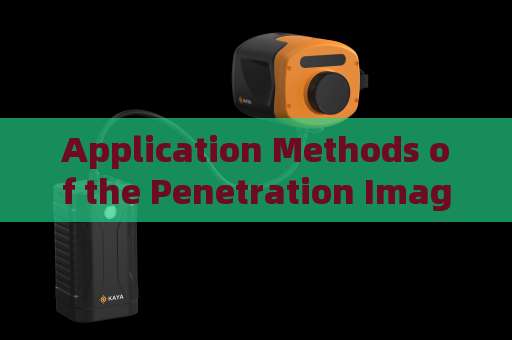
Application Methods of the Penetration Imager for Helping Law Enforcement Covertly Gather Evidence Before Taking Action In a typical surveillance operation, law enforcement officers face the critical challenge of observing suspects inside a stationary vehicle without revealing their presence. Standard optical devices—binoculars or cameras—are rendered useless by heavily tinted windows, reflective coatings, or raindrops and fog clinging to the glass. An officer forced to approach the vehicle risks compromising the entire operation, while relying on thermal imaging may only detect heat signatures without identifying objects or actions inside. The core pain point is the inability to see through optically transparent yet visually obstructing barriers while maintaining a covert standoff distance. This is precisely where the penetration imager offers a decisive tactical advantage. The penetration imager, an advanced active optical system employing laser range-gated imaging (gated imaging technology), directly addresses this problem. Composed of a high-repetition-rate pulsed laser, an intensified gated camera with an MCP image intensifier, high-voltage module, timing module, beam expander, and imaging lens, it delivers high-contrast images even when the target is behind automotive glass. Unlike passive optics that fail when light bounces off a windshield, the penetration imager actively emits a very short laser pulse and opens its camera shutter only when the reflected signal from the target returns, effectively gating out the blinding backscatter from the glass surface. This allows the operator to see through standard automotive window glass, high-speed train windows, aircraft portholes, or glass curtain walls as if the barrier were not there—all while remaining completely covert, as the pulsed laser is invisible to the naked eye and does not betray the operator’s position. In practice, an officer positions the penetration imager at a safe distance—typically 50 to 200 meters—inside an unmarked surveillance vehicle or behind a natural obscuration. The system is aimed at the suspect’s vehicle, and the operator adjusts the range gate to match the distance to the intended target inside the cabin. Within seconds, the monitor displays a crisp, real-time image of the driver and passengers, their hand movements, any contraband in plain view, or communication devices being used. Even in rain, fog, or at night, the active illumination and gating maintain clarity, while the ability to see through fire or smoke (though not thick smoke) further enhances operational flexibility. The captured footage can be recorded as admissible evidence, enabling commanders to assess the threat level and confirm probable cause before executing a warrant or making an arrest. The penetration imager’s role in pre-action evidence gathering is further refined by its ability to operate in rapidly changing light conditions. When a suspect suddenly starts the engine and the interior dome light illuminates, or when a passing vehicle’s headlights sweep across the scene, conventional camera sensors would be overwhelmed. The gated imaging technology automatically compensates, maintaining a consistent image without blooming or washout. This ensures that the critical moment—a hand reaching for a weapon, a bag being exchanged, or a phone displaying a digital map—is never lost. Law enforcement teams thus gain the confidence to delay tactical entry until all intelligence is confirmed, significantly reducing operational risk and preserving the integrity of the covert investigation.