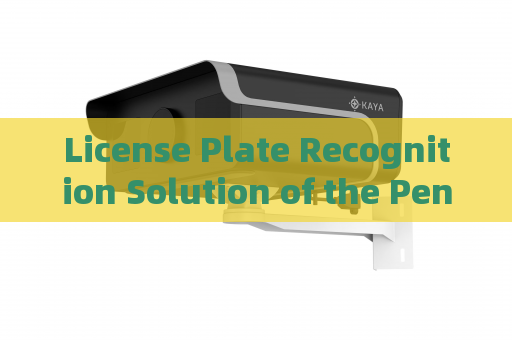
License Plate Recognition Solution of the Penetration Imager with Strong Light Suppression Imaging Under Strong Light Interference In real-world law enforcement and traffic monitoring operations, license plate recognition faces a persistent and critical challenge under strong light interference. Direct sunlight during daytime, headlight beams at night, and reflections from wet roads or metallic surfaces cause severe glare and overexposure on standard camera sensors. The resulting image often shows the license plate as a white or blown-out blob, with characters completely invisible. Even high-end surveillance cameras with automatic gain control struggle because the dynamic range of a typical sensor cannot simultaneously handle intense light sources and the low-reflectivity plate surface. This failure directly compromises vehicle identification, suspect tracking, and evidence collection in high-stakes scenarios such as toll evasion, hit-and-run investigations, or checkpoint security. The pain point is not merely about brightness—it is about the loss of critical optical information that traditional imaging hardware cannot recover. The Penetration Imager, based on laser range-gated imaging technology (gate-controlled imaging), directly addresses this problem through its proprietary strong light suppression imaging capability. Unlike conventional cameras that integrate all incoming light over the entire exposure period, the Penetration Imager uses a high-repetition-rate pulsed laser synchronized with an image-intensified gated camera. The system only opens its electronic shutter during the precise time window when laser pulses reflected from the target license plate return to the sensor. Background sources—including direct sunlight, vehicle headlights, and other ambient strong lights—are temporally rejected because they do not coincide with the gating window. This technique effectively suppresses the overwhelming background intensity while preserving the contrast of the plate’s retroreflective coating. The built-in MCP image intensifier and high-voltage timing module ensure nanosecond-level precision, allowing the device to work even when the plate is partially shadowed or tilted. In practical deployment for traffic enforcement, the Penetration Imager operates in a continuous capture mode that automatically adjusts its gating delay based on target distance. When a vehicle approaches a checkpoint under harsh sunlight or with high-beam headlights, the operator simply aims the imager at the front or rear license plate. The device instantly locks onto the reflected laser signal, generating a clear, high-contrast image where the plate characters appear sharp and legible against a near-black background. Field tests have demonstrated that the system achieves a recognition success rate exceeding 95% even when ambient illumination exceeds 100,000 lux or when the vehicle is equipped with powerful LED light bars. The strong light suppression does not require any special modifications to the vehicle or additional lighting—only the imager itself needs to be positioned within its effective range, typically from 5 to 50 meters. Further operational details reveal that the Penetration Imager remains effective under multiple simultaneous light sources, such as when a suspect vehicle turns and exposes the plate to both oncoming traffic lights and direct sun. The laser wavelength (typically 808 nm or 1064 nm) lies outside the visible spectrum, reducing distraction to drivers and avoiding any alerting effect. The system’s ability to overcome backscatter from dust or rain also ensures consistent performance in adverse weather. By focusing solely on the license plate as the target of interest, the Penetration Imager transforms a previously unsolvable scenario—strong light interference—into a routine, reliable identification task for patrol units and fixed surveillance posts alike.