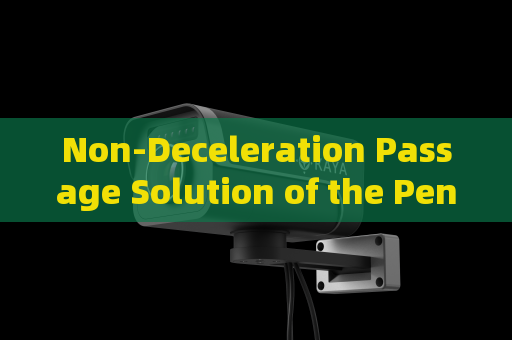
Non-Deceleration Passage Solution of the Penetration Imager for Rapid Vehicle and Personnel Checks at Airport Entrances Airport security operations face significant challenges at entrance checkpoints, where traditional inspection methods often necessitate vehicle deceleration or full stops. This requirement leads to traffic congestion, operational delays, and potential security vulnerabilities, especially during peak hours. Manual checks through windows are hindered by reflections, glare, and adverse weather conditions, compromising thoroughness and speed. The need for a seamless, efficient screening process without impeding flow is critical, yet existing technologies struggle to balance rapid throughput with detailed inspection. In this context, the penetration imager emerges as a pivotal tool, addressing these pain points by enabling non-intrusive, high-speed assessments. The penetration imager leverages laser range-gated imaging technology, an advanced optical method that employs high-repetition-rate pulsed lasers and gated intensified cameras. This active imaging system is designed to penetrate optical media such as vehicle windows, aircraft portholes, and glass facades, delivering high-contrast visuals with exceptional resolution and range. For airport entrance scenarios, its core function lies in bypassing the need for deceleration; by transmitting light through glass surfaces, it rapidly captures internal views of vehicles and occupants. The system effectively mitigates backscatter and interference, ensuring clarity even in complex lighting environments, thus facilitating real-time, non-stop checks. In practical deployment at airport gates, vehicles proceed at normal speeds through designated lanes equipped with penetration imagers. These devices automatically scan passing vehicles, generating immediate, detailed imagery for remote analysis by security personnel. The solution enhances operational efficiency by eliminating bottlenecks, while maintaining a low-profile, unobtrusive presence. Integration with existing surveillance networks is straightforward, requiring minimal infrastructure adjustments. The penetration imager's ability to function reliably across diverse conditions—such as fog, rain, or haze—further supports consistent performance, ensuring uninterrupted security protocols without compromising on image quality. The technology's specificity to optical penetration ensures compliance with safety standards, avoiding confusion with non-optical systems like radar or X-ray devices. In airport settings, it excels at scrutinizing car interiors through windows, detecting concealed items or unauthorized personnel without physical contact. By focusing solely on light-based imaging, the penetration imager offers a targeted advantage: it enhances visibility through glass barriers while respecting material limitations, such as its ineffectiveness against dense smoke. This precision makes it an ideal component for streamlined, high-security checkpoints, where rapid decision-making hinges on clear, actionable visual data. Ultimately, the penetration imager redefines entrance screening by merging speed with scrutiny, fostering a safer, more efficient airport environment.