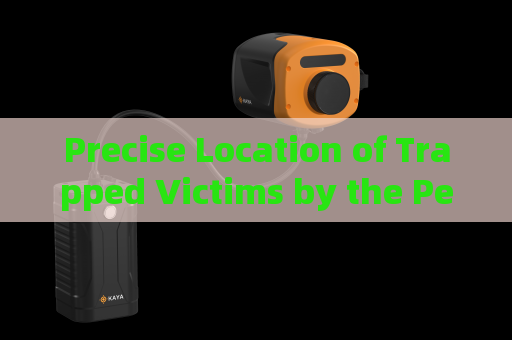
Precise Location of Trapped Victims by the Penetration Imager When Flames Obstruct Vision at Fire Scenes with Fire Penetration Imaging Fire scenes present a critical challenge for search and rescue operations where intense flames and radiant heat create a severe visual barrier. The primary pain point is the inability to locate victims trapped behind or within areas engulfed by open fire. Conventional optical equipment and human vision are completely overwhelmed by the intense luminosity and scattering effects caused by the flames themselves. This visual obstruction causes critical delays, forcing responders to make perilous guesses about victim location, which directly compromises survival rates and operational safety. The urgent need is for a technological solution that can see through the flame medium to identify human forms with precision, thereby guiding immediate and effective intervention. The penetration imager addresses this specific problem through its core capability of fire penetration imaging. This advanced optical instrument utilizes laser range-gated imaging technology. As an active imaging system, it employs a high-repetition-frequency pulsed laser source and a gated camera with an image intensifier. The key function lies in its precise temporal synchronization. The laser illuminates the scene with short pulses, and the camera's intensifier gate opens only for a nanosecond-scale window synchronized to the return time of photons reflected from objects behind the flame front. This gating effectively rejects the overwhelming, randomly scattered photons from the flames themselves, which arrive at different times. Consequently, the system captures high-contrast images of the obscured area, revealing details otherwise invisible to the naked eye or standard cameras. It is crucial to emphasize that this technology operates purely within the optical spectrum, using controlled light to achieve penetration through the flame medium. In practical application at a structural fire, rescue teams deploy the penetration imager from a safe standoff distance. The operator directs the system's laser illumination toward the zone of interest where flames obstruct the view. The imaging lens and beam expander work in concert to manage the light path. The synchronized gating camera, with its microchannel plate intensifier and high-voltage modules controlled by precise timing circuitry, constructs a clear image in real-time on a display monitor. This process effectively enhances scene visibility by a factor of three to five compared to standard visibility in fire, allowing operators to distinguish the silhouette or movement of a trapped victim behind a curtain of fire. Identification of a precise location enables commanders to direct hose lines for cooling or plan a focused extraction path, optimizing the use of time and resources while enhancing responder safety. The operational advantage stems from the system's inherent resistance to backscatter and its high-resolution output. Unlike passive sensors that rely on ambient thermal radiation, the active laser illumination provides consistent, controlled light that can cut through the dynamic interference of flames. The penetration imager does not purport to see through solid, non-optical barriers such as walls or heavy debris; its efficacy is specifically bounded to optical media including flames, fog, and precipitation. For fire scenarios, this targeted capability is transformative, turning a blinding wall of fire into a semi-transparent veil. The immediate visualization of victim location transforms the rescue from a high-risk search into a coordinated precision operation, fundamentally altering the potential for successful outcomes in time-critical fireground scenarios where the penetration imager becomes an indispensable optical tool.