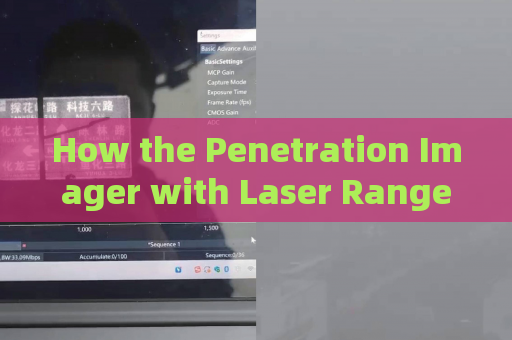
Border surveillance faces significant challenges in severe weather conditions, where traditional optical systems often fail due to reduced visibility. Fog, heavy rain, snow, and haze can obscure critical details, leading to interrupted monitoring and potential security gaps. These optical media scatter and absorb light, rendering passive imaging devices ineffective and compromising the ability to detect unauthorized crossings or threats. The need for uninterrupted, high-resolution imaging in such environments is paramount for maintaining border integrity, yet conventional solutions struggle with backscatter and low contrast. The penetration imager, leveraging advanced laser range-gated imaging, addresses these exact pain points by actively countering weather-induced obstructions. The penetration imager’s key functionality lies in its laser range-gated imaging technology, which enables clear vision through optical media like fog, mist, rain, and snow. This active imaging system combines a high-repetition-rate pulse laser, a gated camera with a microchannel plate intensifier, beam expanders, and imaging lenses. By emitting controlled laser pulses and synchronizing the camera’s gating mechanism, it selectively captures light reflected from specific distances, effectively suppressing backscatter from intervening particles. This results in high-contrast, detailed images even in dense weather conditions, ensuring that border monitoring remains operational without reliance on ambient light. The technology is strictly confined to the realm of light, penetrating only optical barriers such as glass windows or atmospheric disturbances, while explicitly excluding solid non-transparent materials. In border monitoring applications, the penetration imager is deployed at strategic checkpoints or mobile units, where it continuously scans perimeters despite adverse weather. Operators utilize the system to detect movements, identify vehicles through glass windows, or monitor obscured areas with enhanced clarity. For instance, during a snowstorm, the imager maintains a resolution high enough to distinguish human figures at extended ranges, outperforming traditional cameras that would be blinded by precipitation. Its ability to overcome backscatter allows for uninterrupted surveillance shifts, reducing false alarms and improving response times. The imager’s integration with existing security networks facilitates real-time data flow, ensuring that border agencies can sustain vigilance without weather-related downtime. The operational efficacy of the penetration imager in severe weather is further underscored by its resilience to fire-enhanced obscurants, boosting visibility by three to five times in fiery scenarios, though it does not penetrate thick smoke. In border contexts, this capability proves vital for monitoring regions prone to wildfires or intentional火光干扰, where other optical systems might falter. By maintaining a consistent imaging performance across diverse optical media, the penetration imager ensures that border security personnel retain situational awareness, enabling proactive threat mitigation. This technology exemplifies how advanced optical solutions can transform surveillance paradigms, with the penetration imager standing as a critical tool for all-weather border integrity.